Pearls Before Breakfast – washingtonpost.com

Pearls Before Breakfast – washingtonpost.com

“On Friday, January 12, the people waiting in the lottery line looking for a long shot would get a lucky break — a free, close-up ticket to a concert by one of the world’s most famous musicians — but only if they were of a mind to take note.”

A fascinating Washington Post story on world famous violinist Joshua Bell busking for an hour in a DC metro station. It is long, but worth the read. I tend to agree with the Kantian interpretation, that the results were as much about context as taste…at least hope that is the case.

(Via jw.)

Monk Institute announcement @ Loyola

Today I had the pleasure of attending the standing ovation fest that was the Announcement of the Thelonious Monk Institute of Jazz relocation of its college level program to Loyola University New Orleans. As an alum of Loyola, this good news for me, because my degree’s value just increased noticeably due to my alma mater having a cool new roommate. As an adjunct faculty member at Loyola this greatly increases my chances of running into Herbie Hancock or Wayne Shorter in the cafeteria…or maybe it doesn’t.

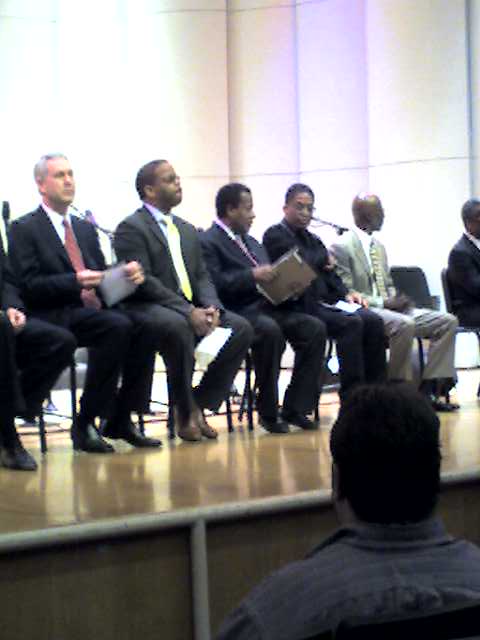
The first part of the ceremony was the regular “guys in suits introducing each other.”

04-02-07_1111.jpg

There were some encouraging remarks, especially in terms of how the Monk Institute sees its role in revitalizing New Orleans. Herbie Hancock put it well: “When jazz flourishes in New Orleans, New Orleans will flourish too.”

Terence Blanchard spoke passionately about the role of music educators in his life. He repeated some good advice he received years ago from Alvin Batiste. “The easiest thing in the world is to play like Coltrane. The hardest thing is to play like yourself. Then you are open to rejection.” Terence also related the closing of a story that Wayne Shorter told him. “It takes courage to be happy.”

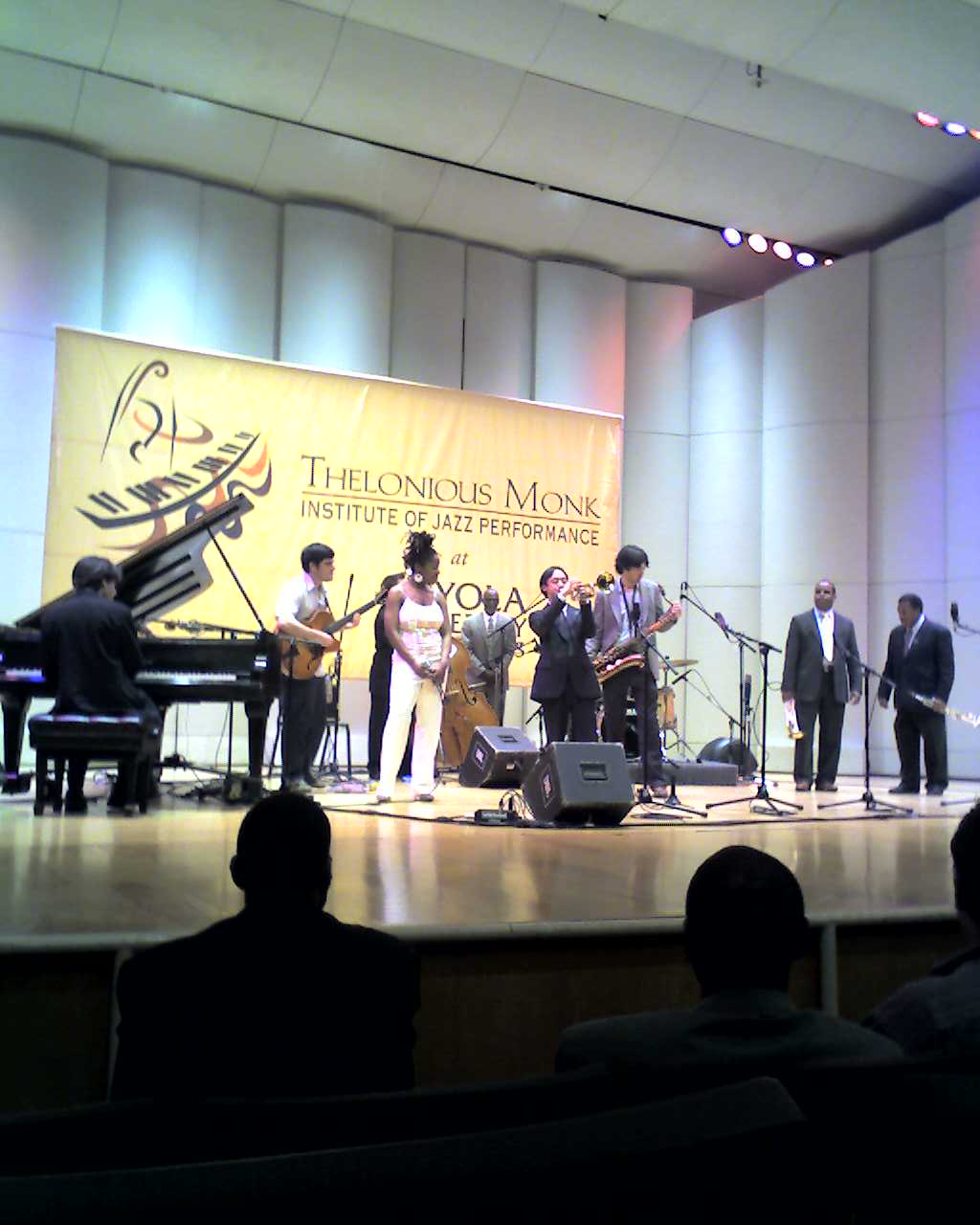
04-02-07_1205.jpg

The next class for the Institute’s college program was introduced and they played “Just Friends.” Next they were joined by Herbie Hancock, Wayne Shorter, Terence Blanchard, and Thelonious Monk, Jr. on “It Don’t Mean a Thing.”

The whole ceremony was positive and it gave me a new ray of hope for New Orleans. Hopefully we can stay in this positive light.

My apologies for the crummy camera phone pics.

Kenny Werner – Lawn Chair Society

I’m not sure how I first became aware of Kenny Werner’s new CD, Lawn Chair Society. It might have been through a magazine ad, or possibly through an online New York Times review of a recent performance by the quintet. I have dug Kenny Werner since my early 20’s when he played with Mel Lewis’ Jazz Orchestra, so the idea of a Kenny Werner CD was interesting to me, but then I read that the band was Chris Potter, Dave Douglas, Scott Colley, and Brian Blade, and that interest ramped up a couple of levels. These guys are all favorites of mine. Interestingly, the album was produced by Lenny Picket. Yes, that Lenny Picket.

The album starts off in a manic kind of vibe. It is energetic in a way that is almost nervous. I like it. It has the kind of energy that won’t let my body be still. It’s not necessarily a funky dance thing, just an energy that causes me to move my body. There are electronic elements to this music, and in the liner notes Werner refers to it as his first “electronic voyage.” I don’t know if I would call it an electric album though. The heart of the music is acoustic, and the electronics are just one of the colors present. It at times calls to mind Douglas’ Keystone, and Potter’s Underground. I almost hate to even draw those comparisons, because someone will think they sound nothing alike, but they evoke similar vibes for me, and I think if you like Underground or Keystone, you will dig Lawn Chair Society.

While much of the album has the frenetic energy I mentioned above, there are a couple a drastic departures from that vibe. The fourth track, “Uncovered Heart”, is beautiful and sensitive with an arresting melodic presentation from bassist Colley. The ninth track is entitled “Loss”, and that is what it sounds like. It is deep and dark and moving. This flows into the trance-like “Kothbiro”, which closes the album with a slow and gradual journey from the dark back into a brighter place, then on to a peaceful conclusion. I realize that this may make the album seem a bit bipolar, but it really rides a nice organic curve that takes it to all of these spaces.

Full Disclosure: I didn’t buy this CD, but was given a copy by the promotion firm that is handling this release. It arrived unexpectedly, but serendipitously, because earlier that day I had thought to myself that I needed to order a copy of this CD.
A Lesson From the Jazzmatician – March 27, 2007 – The New York Sun

A Lesson From the Jazzmatician – March 27, 2007 – The New York Sun:

“The 61-year-old Mr. Braxton seems to do everything possible to present his music in a way that makes it sound serious and artsy, which is to say foreboding and inaccessible. Even his physical appearance —bespectacled, sweater-wearing, pipesmoking — is outwardly academic. But when you open your ears to what he’s playing, Mr. Braxton’s compositions are surprisingly listenable. Granted, there are long interludes of screeching and shrieking on his various horns that naught but a hardcore avant-garde admirer would relish, but for all his academic posturing, much of his music is playful, swinging, witty, and — dare I say it? — fun.”

We should let more music be fun, or better yet, realize that more music is fun.

(Via Soundslope.)

DJA out in blaze of glory (at least for a minute) and home jazz recording

Darcy is putting his Secret Society blog on a bit of a hiatus. He’s acting like he has to actually do some work or something. His most recent post however links to enough stuff to keep you reading until May anyway. I won’t link to all of it, just go over there and see for your self.

One discussion that I would like to add to is the one about home recording as it relates to jazz. It started with Daniel Melnick, who writes at Soundslope. He wrote:

What it really made me think about and wonder is if jazz has moved towards having more home based recording environments, as many rock musicians and producers have, and if it hasn’t, why is that the case? Recording technology keeps getting cheaper, so why is the studio even in the equation? I wonder if it has something to do with the technical difficulties of recording jazz. I would assume, based on my own rudimentary knowledge of microphones and recording technology, that making a good jazz recording requires a higher level of mastery than the average home recordist possesses. Nevertheless, I think it makes sense for jazz artists to look beyond the traditional studio environment as a means of making records if there is really value in being able to spend more time recording.

Then DJA replied:

A few factors that may partially explain why home-recorded albums don’t happen more frequently in jazz: [1] Lo-fi, as an aesthetic, lacks widespread acceptance in jazz circles — when you’re recording acoustic instruments, there really is no substitute for a good recording engineer using good mics in a really good space. [2] The buy-in and setup costs for a home studio, while falling, are still well beyond the means of many jazz musicians, especially young artists … [3] In New York, at least, many if not most musicians do not live in spaces where they can play (especially when there is a drummer invovled). [4] As a corollary to [3], many New York musician apartments are barely large enough to serve as functional living spaces as it is. Where are you going to put the home studio?) [5] The number of home-recorded commercially-released nonjazz CDs is vastly exaggerated — unless you count things like Prince records as “home recorded,” which is obviously absurd. The overwhelming majority of successful and semi-successful albums are still cut in professional recording studios.

To me the biggest issue is that you can’t record jazz one player at a time. I could pretty easily cut a pop tune on the gear I already have here in my house, especially if I used programmed drum sounds, and I don’t have a huge setup here. It would be much harder to do a jazz record, because I can’t have the bass player play, then track the sax, then the trombone, etc. It is also very hard to engineer and play any sort of session, and that is just magnified on a jazz session. There are two very different types of mental focus required, and they almost cannot exist concurrently. If I were doing a home CD with my rock band one of the other guys could engineer while I laid my parts.

I have done one album completely DIY on my laptop with two mics, but it is a duet album with only trombone and guitar. Not having to record drums makes DIY much easier. It is a download only release, and you can check it out here. Interestingly, that album is the only project that I have done that was in the black in any sort of reasonable time after its release, because it cost nada to make.

NewMusicBox : New Music Economics (Part 2): The Malady Lingers On

NewMusicBox: “New Music Economics (Part 2): The Malady Lingers On”

This is a very interesting look at the economics of performance.

In 1918, Igor Stravinsky composed The Soldier’s Tale, a new-music/theatre piece designed for a performance tour; it was initially unsuccessful and lost money. In 1976, Philip Glass premiered his own theatrical production, Einstein on the Beach; it was quite successful, playing to capacity audiences on both sides of the Atlantic. Nevertheless, it also lost money. (Glass wrote that during Einstein’s brief, sold-out run at the Metropolitan Opera House in New York, the deficit was $10,000 a night.)

What happened? Stravinsky had the misfortune of seeing his planned tour cancelled due to a worldwide influenza outbreak. Glass fell victim to a subtler ailment: Baumol’s cost-disease.

Check out Part I of the series here.

(Via artsJournal.)

Noise complaints could silence jazz at King Bolden’s

New Orleans CityBusiness — The Business Newspaper of Metropolitan New Orleans: “Noise complaints could silence jazz at King Bolden’s”

Actually, they already have, at least temporarily. I was quoted in this piece.

“If we start closing the places where we can be creative and practice our art over stupid stuff it makes you want to leave,” said trombonist Jeff Albert, a King Bolden’s regular. “Before the place was King Bolden’s it was a gay strip bar/disco club. How can having a jazz band be a downgrade from a gay strip club/disco bar?”

I just want to clarify that if it had been a straight strip club disco bar, my point would be the same. Either way it would have been louder than an acoustic jazz group with no PA. Leo Watermeier, the same moron that has been busting WWOZ’s balls for years, had this to say later in the piece:

Watermeier said he doesn’t lament the loss of another jazz club in New Orleans.

“I don’t think there’s a huge market for more jazz places,” he said. “Even Donna’s struggles. It’s mostly a tourist thing. Locals don’t go sit and listen to jazz bands.”

Every time I have played King Bolden’s the crowd has been mostly if not all locals. King Bolden’s has been the site of some really great music. Vibrations that can make the world a better place. I’ve blogged about a few of them.